
TMT Examination (Treadmill Test)
A treadmill (TMT) test, also known as a cardiac stress test, determines how far your heart can go before developing an irregular heartbeat or a lack of blood supply to the heart muscle. It enables your doctor to examine how your heart responds when pressed. You'll have to walk or run, with the difficulty gradually increasing.
TMT Test Levels That Are Normal
The maximum expected heart rate for adults is 220, which is your age. So, at the age of 40, your maximum heart rate prediction is 220 - 40 equals 180. Some clinicians aim for 85 percent of the expected maximal heart rate during diagnostic treadmill testing.
A cardiologist should be consulted if any of the values are abnormal.

Questions and Answers
1 - Why should you run on a treadmill?
Typically used to diagnose coronary artery disease or to assess prognosis after a myocardial infarction (heart condition) or coronary surgery
2- Is fasting required for the treadmill test?
Yes, you should fast for 12 hours before the test. You can drink water four hours before the test
3- Who should be examined?
Patients with angina, a history of heart attack, and angioplasty/bypass surgery
4- What precautions should patients take before undergoing TMT?
You have the option of skipping a meal. Water is permitted, and any blood pressure medications should be discussed with a doctor. Some blood pressure medications must first be stopped.
5- Is fasting required?
It's best to avoid eating or drinking for at least two hours before the test. The patient may drink water if they so desire.
6- How long does it take to perform a TMT test?
The whole thing takes about an hour. The examination will last ten to fifteen minutes. It takes about 15 minutes to prepare.
7- How is the Treadmill Test carried out?
After taking a history and checking vitals, chest leads are attached, and the patient is informed that the machine will gradually increase the speed with a slope every 3 minutes.
8- When a test results in a positive result, what does it mean?
A positive test indicates that the patient's ECG has changed as a result of exertion-induced angina (inadequate blood flow to the heart). It means the patient has ischemic heart disease.
9- What exactly does a bad report mean?
A negative result indicates that the patient's heart has adequate blood flow even under moderate or high strain, and no symptoms of cardiac disease are present.
10- What are the risks associated with this test?
It is possible that angina, dyspnea, or arrhythmia will worsen. These issues are 1% likely to occur.
What exactly is an Echocardiogram?
An Echocardiogram, also known as an echo.
It is a type of ultrasound examination that uses sound waves to create moving
images of your heart.
What is the purpose of an Echo-Cardiogram?
An Echo-Cardiogram can assist your doctor in learning vital information about your heart health. It will determine whether your heart, heart valves, and the amount of blood pumped out by your heart are normal or if you have heart disease or another heart condition.
-
If you have any of the following symptoms, you may require an
echo-cardiogram:
- Chest pain or pressure,
- Shortness of breath,
- Irregular heartbeats,
- Abnormal heart sounds are all signs and symptoms of a heart problem.
- Have you had a heart attack or had heart surgery?
- Have a heart condition such as cardiomyopathy (heart muscle disease) or heart valve disease?
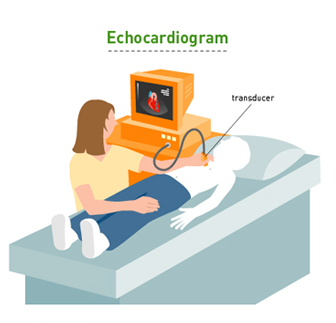
What Should You Expect During an Echocardiogram?
A specially trained technician will perform your test in a doctor's
office or diagnostic center,or hospital. There are no special preparations required, and
the test usually lasts 30 to 60 minutes.
The test will be performed in a darkened room so that your technologist can see the test
monitor more clearly. You will undress from the waist up and put on a hospital gown
before lying down on an exam table.
Your technologist will stick electrodes to your chest to monitor your heart rhythm with
an electrocardiogram or EKG. Next, your technologist will apply gel to your chest and
move a small device called a transducer back and forth against your chest over your
heart. The transducer detects and transmits sound waves, which travel to the test
monitor and display images of your heart.
You will spend the majority of the test lying on your left side. It is possible that you
will need to lie on your back and hold your breath for a few seconds at a time. You may
hear a whooshing sound during the test, which is the sound of blood moving through your
heart.
The Results of an Echocardiogram
In most cases, your doctor will have the results of your
echo-cardiogram within 30 minutes to 1 Hour and will go over them with you. The
following outcomes are possible:
Normally refers to your heart, heart valves, and the amount of blood your heart pumps
out.
Abnormal, which may include your heart chambers or valves not working properly, the
amount of blood your heart pumps out being insufficient to meet your body's needs, there
being extra fluid around your heart, or you having a tumour or blood clot in your heart.